Two weeks before the midterms, we at the National Conference on Citizenship, working with researchers at The Carter Center, asked a national sample of Americans a simple question: have you used an AI chat program, something like ChatGPT or Gemini, to learn about the candidates for U.S. Senate, House or Governor as you decide how to vote?
In the first days of October, 14% said yes. By the middle of the month, 25% did.
That is one in four adults bringing an AI assistant into their decision in the biggest races on the ballot, and the number nearly doubled in two weeks. We ran the same questions twice, two weeks apart, on SSRS’s national probability-based panel, with about 1,030 people each time, so we can say with confidence that this is not a blip in the data.
We asked about four election tasks. Every one of them rose by roughly the same amount:
| Used AI to… | Oct. 1–4 | Oct. 15–18 |
|---|---|---|
| Learn about candidates for Senate, House or Governor | 14% | 25% |
| Learn about local candidates and ballot measures | 16% | 25% |
| Check whether an election story was accurate | 16% | 25% |
| Find out when, where or how to vote | 11% | 21% |
| Any of these four | 28% | 40% |
Nearly one in five adults (18%) have used AI for three or more of these tasks.
When we asked people to describe in their own words what they had asked, the answers were practical. “I asked AI to summarize two candidates’ platforms and compare them.” “Asked about where the governor candidates stand on issues.” “I asked when early voting was taking place, and it gave me the dates and locations.” “Asked how to request an absentee ballot.”
Here is the part that should give everyone pause. While use jumped, trust stayed put, and it is low.
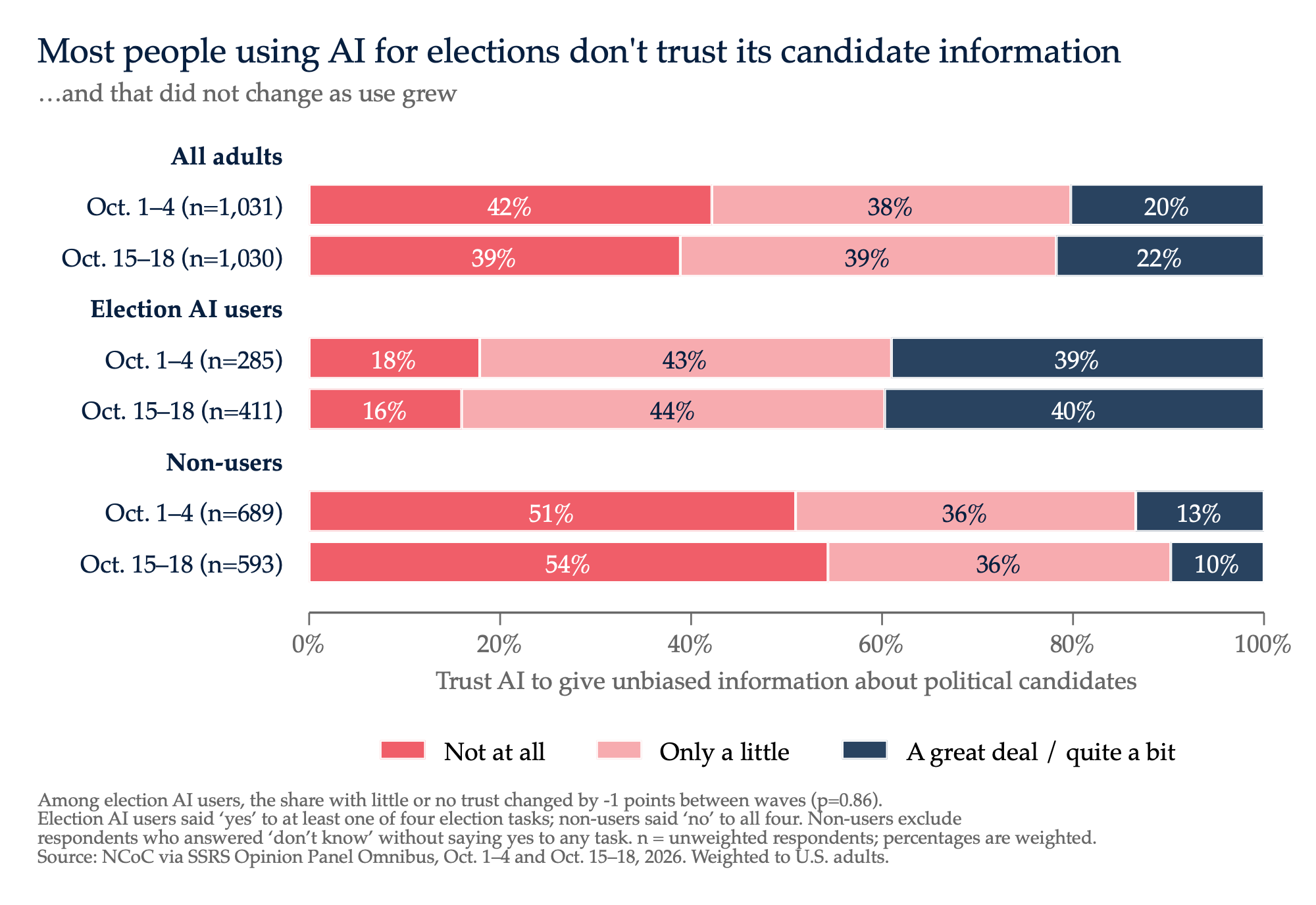
Only about one in five Americans trust AI “a great deal” or “quite a bit” to give them unbiased information about candidates. The same is true for giving complete information about the election without leaving things out. Those numbers did not change between our two surveys.
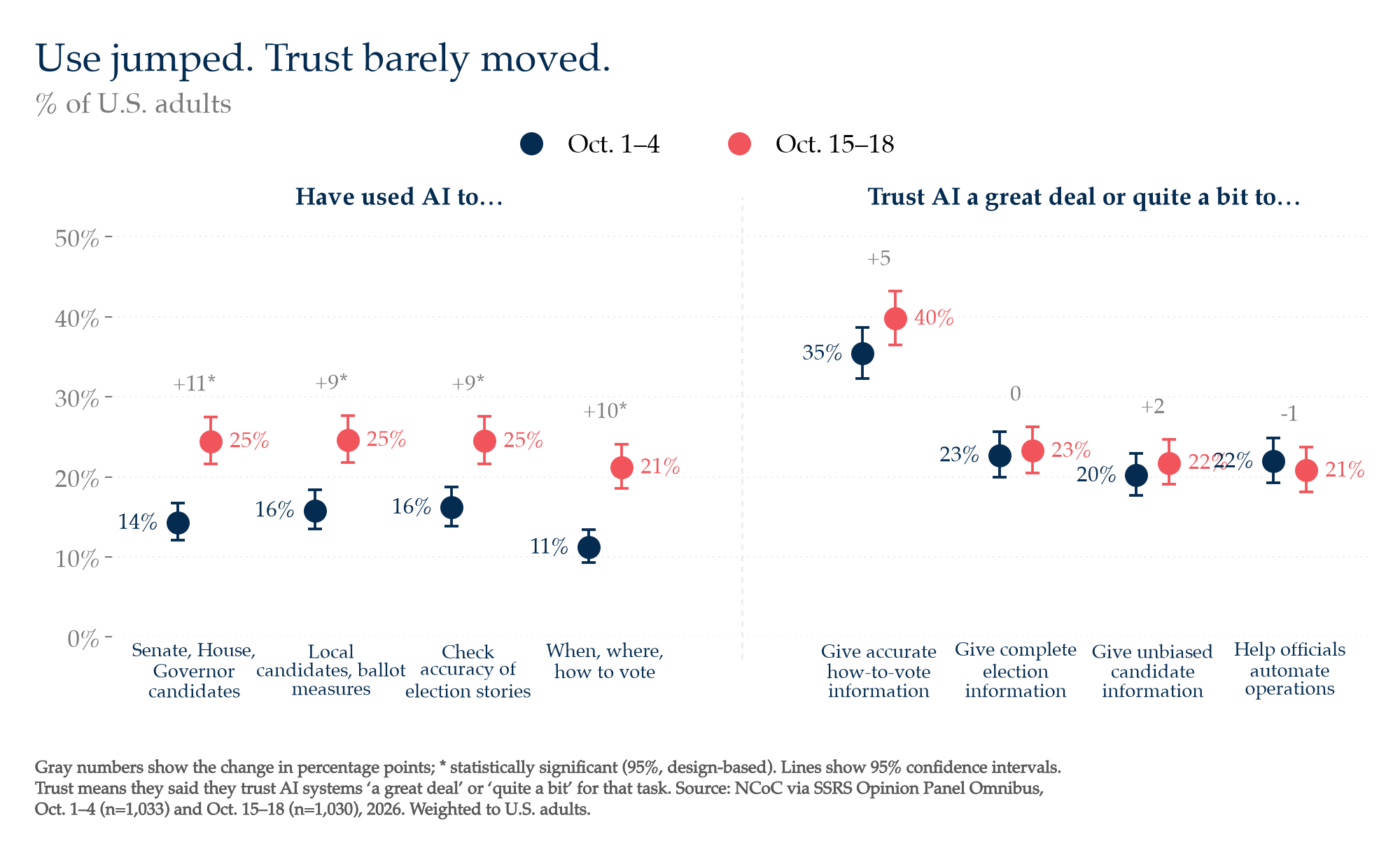
The one thing people are more willing to trust AI with is logistics: 40% trust it to tell them when, where and how to vote. That makes sense. Those are facts you can check.
Most striking: among the people who are using AI for election tasks, 60% say they trust it only a little or not at all to be unbiased about candidates. People are using these tools while doubting them. That is a reasonable posture, and it is also a fragile one.
Use is strikingly bipartisan. Republicans (39%) and Democrats (41%) report almost identical use, and both rose by the same amount.
The biggest differences are by race and ethnicity. About half of Black and Hispanic adults (51% each) have used AI for an election task, compared with about a third of White adults (32%). That gap holds on every task, in both surveys, and it holds after accounting for age, education, income, party and everything else we measured. It is widest on the most consequential questions: in early October, Black, Hispanic and other non-white adults were about three times as likely as White adults to have asked AI when, where or how to vote. Registration rules, ID requirements and polling places are exactly the details where a wrong answer can cost someone their vote.
In two weeks the profile of users also shifted. Early in October, men and women, and young and old, were using AI for elections at similar rates. By mid-October, men had pulled well ahead of women (46% vs. 33%) and adults under 50 well ahead of those 65 and older (around 48% vs. 24%).
At NCoC we run the Civic AI Audit, which tests how the major AI products actually answer voters’ questions about elections. This survey is the other half of that picture: how many people are asking, and how much they believe what they hear. The answer, as of mid-October, is that a lot of people are asking, more every week, and they are right to be cautious.
Two notes on reading these numbers. The question asks whether people have used AI for these tasks at any point this election, so some growth is natural as Election Day approaches. And these are self-reports: a few respondents who said yes went on to tell us they hadn’t really used AI, and some were describing the AI summaries that now appear at the top of search results. The levels are approximate. The direction is not.
If you are going to ask an AI assistant about your ballot, do what the most careful respondents in our survey told us they do: treat the answer as a starting point, and confirm the details that matter, especially when and where to vote, with your state or local election office.
Read the full analysis, toplines and methodology: ncoc.org/ai-midterms-report
Survey commissioned by the National Conference on Citizenship in collaboration with researchers at The Carter Center. Fieldwork by SSRS on its Opinion Panel Omnibus, Oct. 1–4 (n=1,033) and Oct. 15–18, 2026 (n=1,030). Margin of error ±3.4 percentage points for each survey.